Houston Area Pediatric Specialists

Independent pediatric specialists aim to serve our community. We want to share news and analysis regarding our specialties and our practices.


Showing posts with label child sleep specialist houston. Show all posts

Tuesday, June 4, 2013

ATS: Adenotonsillectomy Offers Relief to Kids With Sleep Apnea

Are some cognitive deficits associated with obstructive sleep apnea inevitable, or are we not detecting this problem early enough? Dr. Susarla


ATS: Adenotonsillectomy Offers Relief to Kids With Sleep Apnea


TUESDAY, May 21 (HealthDay News) -- Compared to watchful waiting, early adenotonsillectomy improves some symptoms, but not attention or executive function, in school-age children with obstructive sleep apnea syndrome, according to a study published online May 21 in the New England Journal of Medicine to coincide with presentation at the annual meeting of the American Thoracic Society, held from May 17 to 22 in Philadelphia.
Carole L. Marcus, M.B., B.Ch., from the Children's Hospital of Philadelphia, and colleagues randomized 464 children (aged 5 to 9 years) with obstructive sleep apnea syndrome to either early adenotonsillectomy or watchful waiting. At baseline and after seven months, polysomnographic, cognitive, behavioral, and health outcomes were assessed.
The researchers found that the change in attention and executive function score on the Developmental Neuropsychological Assessment did not significantly differ between study groups (mean improvement, 7.1 in the early-adenotonsillectomy group and 5.1 in the watchful-waiting group). In the behavioral, quality-of-life, and polysomnographic findings, there were significant reductions in symptoms in the early-adenotonsillectomy group. A larger proportion of children in the intervention group had normalization of polysomnographic findings than did in the watchful waiting group (79 versus 46 percent).
"As compared with a strategy of watchful waiting, surgical treatment for the obstructive sleep apnea syndrome in school-age children did not significantly improve attention or executive function as measured by means of neuropsychological testing but did reduce symptoms and improve secondary outcomes of behavior, quality of life, and polysomnographic findings, thus providing evidence of beneficial effects of early adenotonsillectomy," the authors write.

Friday, January 18, 2013

Sleep deficit may underlie kids' ADHD, migraines


Sleep deficit may underlie
kids' ADHD, migraines

Congratulations on raising awareness  Dr Joseph!
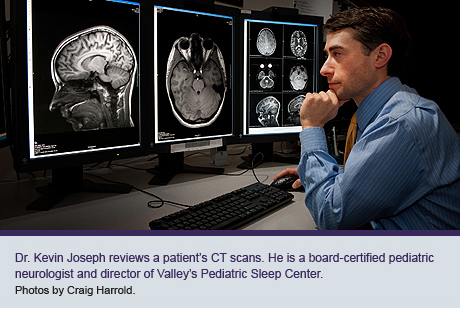
Dr. Kevin JosephThe child displays hallmark behaviors – fidgety, impulsive, irritable, inattentive – and has been diagnosed with ADHD. Dr. Kevin Joseph isn’t stepping through a DSM-IV screening, though. His questions tack in another direction.
“How well does your child sleep?”
Joseph, a board-certified pediatric neurologist and sleep specialist at Valley Medical Center, regularly witnesses the revelations of an overnight polysomnography.

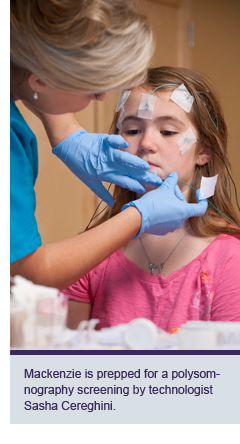
Child in sleep study“I saw a boy, 9 years old, who couldn’t sit still in class, couldn’t remember to brush his teeth. Turns out he had severe sleep apnea, like 101 events per hour, and for a child, normal is 1.5 events,” Joseph said. “His oxygen saturations were down in the 70-80 percent level when they should’ve been 95-100 percent. We sent him for a tonsillectomy and at follow-up his parents reported he was sitting in class, not fighting, even losing some weight.
“He was like a new kid, and they were thrilled. And I never put him on medication.”

When sleep disturbances such as apnea are brought to light, cases of childhood migraines and attention deficit hyperactivity disorder – even epilepsy – often can be ameliorated or resolved.

Joseph studied at Walter Reed Army Medical Center and added training in pediatric neurology at Children’s National Medical Center. In the last four of his nine years of active duty, he treated soldiers for brain injuries in Iraq and was chief of child neurology at Madigan Army Medical Center in Tacoma.

There he saw how a parent’s deployment can subvert a child’s evening routines, spurring migraines and nightmares. More recently, he has witnessed how economic hardship deprives the whole household, not just the breadwinners, of sleep.

“The key difference between pediatrics and adult medicine is that, with pediatrics, you have to attend to the family, not just the child,” Joseph said. “I always ask about stressors at home. If parents are out of work or have financial issues, even if they only talk about those issues behind closed doors, it tends to seep through. It’s easy for me to give guidance about structure a child should have around bedtime. It’s harder for a family to implement, especially in single-parent households.”

The American Academy of Pediatrics in August revised its clinical-practice guideline, recommending that all children and adolescents who snore regularly be screened in a lab setting for obstructive sleep apnea. But snoring isn’t the only red flag: “Daytime learning problems,” the guideline notes, should compel attention, too.
Kid in sleep studyDespite well-documented negatives associated with adult sleep disorders, parents are often surprised to learn about sleeplessness’ impact on a child, Joseph said. Sleep is when growth hormone is secreted, fueling body and brain development.
Joseph’s patients at the Pediatric Sleep Center include NICU preemies and 18-year-olds. They are restless or listless or developmentally delayed. They (or their parents) present with concerns about snoring, night terrors, sleepwalking, headaches and seizures, poor report cards and other events.

For people with epilepsy, disrupted sleep can re-awaken symptoms that medication had largely controlled. Joseph mentioned cases of college freshmen whose newfound freedom led them to join a late-night study session, and then seizures struck anew.

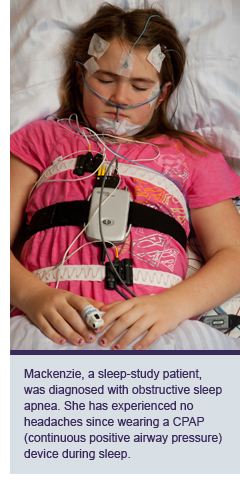
It’s important to get a formal diagnosis of obstructive apnea before a tonsillectomy is weighed, because a child with the condition is at greater risk of postoperative problems with the airway and with bleeding, Joseph said. The usefulness of a CPAP device should be considered, as well, because tonsillectomy doesn’t always bring relief.
“I saw a girl who had migraines that we couldn’t control with medication. She had obstructive apnea. She had a tonsillectomy, which didn’t affect the apnea, but then we put the CPAP on her and her headaches went away,” he said. “It was a huge success for the family. She wears this thing religiously.”

Tuesday, December 11, 2012

AAP Recommendations for Childhood Sleep Disorders

It's been said before, but it warrants reminding that when it comes to sleep disorders, children are not little adults.  Pediatric sleep medicine is a highly specialized field where the specialties of pediatric pulmonology and neurology intersect to help address problems unique to children.  Although polysomnnography, or "sleep studies" are very similar to adults.  The techniques, equipment, scoring methods , and even personnel are highly specialized.

 A long overdue update to the American Academy of Pediatrics Recommendations was recently published specifically addressing the problem of childhood obstructive sleep apnea.  This guideline discusses important symptoms for parents and physicians such as chronic snoring, mouth breathing, and pauses in breathing during sleep.  But it also discusses less recognized features of sleep disorders such as inattentiveness and hyperactivity which can also result from disrupted sleep.  Talk to your pediatrician if you suspect a sleep problem in your child.  Dr. Susarla

AAP Recommendations for Childhood Sleep Disorders

Sleep disturbances, including obstructive sleep apneasyndrome (OSAS), are common in children and can result in significant health problems if left untreated.
In a revised clinical practice guideline, “Diagnosis and Management of Childhood Obstructive Sleep Apnea Syndrome,” published in the September 2012 Pediatrics (published online August 27), the American Academy of Pediatrics (AAP) recommends that all children or adolescents who snore regularly be screened for OSAS.
Additional symptoms can include labored breathing during sleep, disturbed sleep with frequent gasps, snorts or pauses, and daytime learning problems. It is important for children exhibiting signs of OSAS to get a comprehensive diagnosis by having an overnight, in-laboratory sleep study done.
If left untreated, OSAS can result in problems such as behavioral issues, cardiovascular problems, poor growth and developmental delays. Treatments are available that can result in significant improvements in these complications. Adenotonsillectomy is effective in treating OSAS and is recommended as the first line of therapy. Obesity can be a risk factor, so physicians may recommend weight loss in addition to other therapies in overweight or obese children. Post-operatively, physicians should be aware of the criteria suggesting which patients should be admitted and when other treatment should be considered, such as CPAP.

Read article here.

Sunday, September 23, 2012

Using iPads before bed 'can lead to a poor night's sleep'

We all love them.  Unfortunately, these bright LED screens can interfere with our brain's cues that signal sleep onset.  Dr. Susarla


Using iPads before bed 'can lead to a poor night's sleep'

Using tablet computers like Apple’s iPad and Samsung’s Galaxy Note just before bed can lead to a poor night’s sleep, according to research.


More and more people are taking their tablets to bed with them to surf the web, check Facebook or email before switching off the light.
But researchers are warning that the blueish light their screens emit can stop users getting a good night’s sleep.
That is because this type of light mimics daylight, convincing the brain that it is still daytime.
Blue light suppresses production of a brain chemical called melatonin, which helps us fall sleep. This is because our brains have evolved to be wakeful during daylight hours.
By contrast, light which is more orange or red in tone does not suppress melatonin production, perhaps because our brains recognise it as a cue that the day is ending.
However, because mobiles and tablets are by nature portable - not to say addictive - more people are taking them into the bedroom.
Users also tend to hold them much closer to their eyes than a computer or television screen.
Researchers at the Lighting Research Centre, at the Rensselaer Polytechnic Institute in New York, are warning that looking at tablet displays for more than two hours “leads to a suppression of our natural melatonin levels as the devices emit optical radiation at short wavelengths” - in other words, they emit bluer light.
They say: “Although turning off devices at night is the ultimate solution, it is recommended that if these devices are used at night displays are dimmed as much as possible and that the time spent on them before bed should be limited.”
They drew their concludions after measuring melatonin levels in 13 volunteers, after they had spent time viewing iPads at full brightness at a distance of 10 inches, for two hours.
Melatonin levels were significantly lower after they had done this, than they were after the volunteers had viewed their iPads for the same time, but while wearing orange glass goggles, which cut out the blue light.
They wrote in the journal Applied Ergonomics that tablet makers could "tune the spectral power distribution of self-luminous devices" so that they disrupted the sleep patterns of users less.
It is not just a good night’s sleep that could be jeopardised by too much late night screen time.
Researchers know that persistent disruption to sleep patterns can lead to an increased risk of obesity, and even breast cancer.
However, these studies tend to be comparisons of those with chronic sleep disruption, such as long term shift workers, with those who have normal sleep patterns.