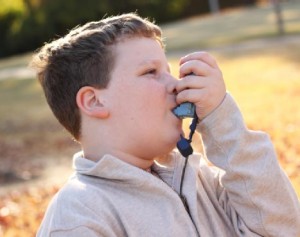
Obese children exposed to high levels of air pollutants were nearly three times as likely to have asthma, compared with non-obese children and lower levels of pollution exposure, report researchers at Columbia University Medical Center (CUMC), including Columbia's Mailman School of Public Health.
Rates of childhood obesity and asthma have both increased dramatically in the past 30 years. The percentage of American children who are obese has increased from 7% in 1980 to 20% in 2008. Childhood asthma is up from 4% in 1980 to 10% in 2009. Rates are higher among urban minority populations.
The researchers followed 311 children in predominantly Dominican and African-American neighborhoods of New York City. They monitored indoor air in each child’s home for two weeks at age 5 or 6, to measure exposure to a family of air pollutants, polycyclic aromatic hydrocarbons (PAH). The child’s height and weight were measured and respiratory questionnaires were administered. In all, 20% were found to have asthma and 20% were categorized as obese based on body mass index.
The researchers found that high PAH exposure was associated with asthma only among obese children. In particular, the association was with the alkylated forms of PAH, which are emitted by vehicles and by cigarette smoke, cooking, incense, burning candles, and various other indoor sources. A two- to three-fold increase in asthma risk was seen among obese children exposed to high levels of the PAH chemicals 1-methylphenanthrene and 9-methylphenanthrene. Exposure to PAH or obesity alone did not predict asthma.
“Our results suggest that obesity may magnify the effects of these air pollutants, putting children at greater risk for having asthma,” says lead author Kyung Hwa Jung, PhD, associate research scientist in the Department of Medicine at Columbia University College of Physicians and Surgeons (P&S).
The mechanism behind the association is not well understood. One possible explanation is that sedentary lifestyle in obese children could result in more time spent indoors, thereby increasing exposure to indoor PAH. Another may have to do with more rapid breathing in those who are obese.
Better understanding of the risk factors opens the door to more targeted interventions. “These findings suggest that we may be able to bring down childhood asthma rates by curbing indoor, as well as outdoor, air pollution and by implementing age-appropriate diet and exercise programs,” says senior author Rachel Miller, MD, Professor of Medicine (in Pediatrics) and Environmental Health Sciences, chief of Pediatric Allergy and Immunology at CUMC, and co-deputy director of the Columbia Center for Children’s Environmental Health at the Mailman School of Public Health.
The study builds on earlier research findings that linked increased asthma risk with exposure to higher levels of air pollution. Drs. Jung and Miller previously had shown an association between repeated high prenatal and childhood PAH exposure and asthma. A number of studies also have found an association between obesity and asthma.
Support for the study was provided by the National Institute of Health grants R01ES013163, P50ES015905, P01ES09600, R01ES08977, and P30ES09089; Environmental Protection Agency grants R827027, RD832141, and RD834509; the Educational Foundation of America; the John and Wendy Neu Family Foundation; the New York Community Trust; and the Trustees of the Blanchette Hooker Rockefeller Fund.
Matthew Perzanowski, Andrew Rundle, Kathleen Moors, Beizhan Yan, Steven N. Chillrud, Robin Whyatt, David Camann, and Frederica P. Perera also contributed to the study. None of the authors has financial relationships with a commercial entity that has an interest in the subject of this manuscript.
Full results are published in the journal Environmental Research.
Read more here

